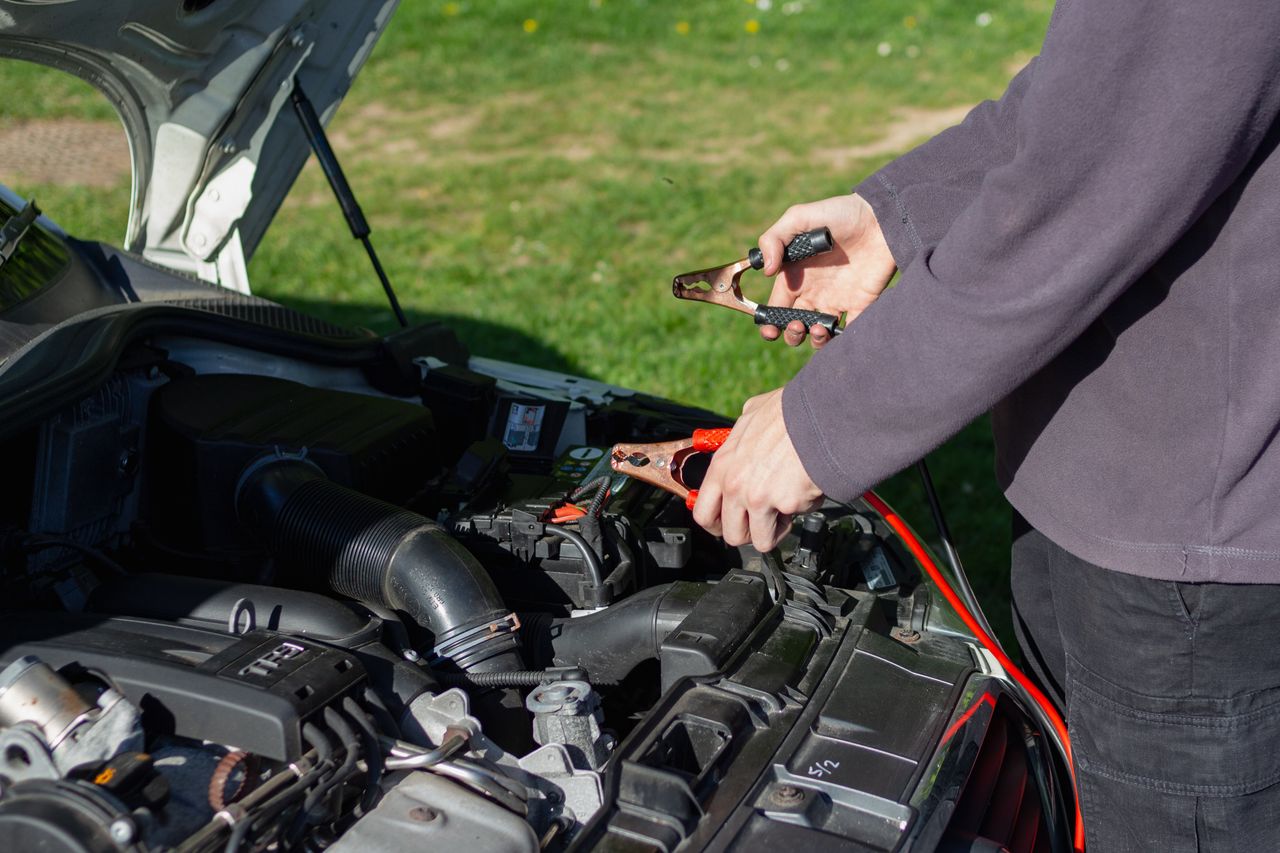
The phone rang at 2 a.m. A driver, stranded, car completely dead, not going anywhere. Fifteen minutes later our technician was standing in front of his open hood. That call ended like most of them do: engine running, driver back on the road. But here's what most people never see: the 30-second decision the technician makes before touching a single cable: does this battery need a boost, or is it done? Get that call wrong and you're stranded again on Thursday. This is how iFAST Roadside Assistance actually makes it, and how you can read the same signs yourself.
The First 30 Seconds: What the Sound of Your Car Is Telling Us
Before we test anything, we ask you to turn the key one more time, because the sound your car makes is the first diagnostic. There are really only three sounds, and each one points somewhere different:
- 01
Rapid clicking, like a machine gun
The classic dead battery. There's enough power to snap the starter relay but not enough to turn the engine. Good news: this usually boosts cleanly.
- 02
A slow, groaning crank: "rrr… rrr… rrr"
The battery is dying, not dead. It might catch this time, but a battery that groans on a mild day will not survive the next cold snap. This is the sound of a battery on borrowed time.
- 03
One click, or total silence
Could be a deeply dead battery, a corroded connection, or a failed starter. This is where a technician who tests before boosting saves you from buying a battery you didn't need.
One more tell before we even pop the hood: your dash lights and headlights. Bright lights with a no-start points away from the battery. Dim, flickering, or dead lights point straight at it.
Boost or Replace? The Honest Answer Nobody Puts on a Flyer
Here's the part that matters: a boost starts your car. It doesn't fix why it died. Sometimes the "why" is innocent. Sometimes the boost is just a band-aid on a battery that's already finished. This is the actual decision tree we run on your driveway:
A boost is probably all you need if…
- You left the headlights, an interior light, or the hazards on overnight, and there's a clear, one-time reason it drained.
- The battery is under about 3 years old.
- The car sat unused for a couple of weeks (batteries self-drain, especially with modern electronics sipping power).
- After the boost, it starts strong on its own the next morning.
The battery is telling you it's done if…
- This is your second boost in a month. A healthy battery doesn't need rescuing twice.
- It's 4 to 5+ years old. In our climate, that's a full career.
- It cranks slowly even on a warm afternoon: weak warm means dead cold.
- The case looks swollen or the terminals are heavily corroded, and physical damage doesn't recover.
Why we test before we sell
Our technicians carry a battery tester, and it runs before any recommendation. If the test says your battery is healthy and you just left a light on, you get a boost and a handshake, not a sales pitch. If it's genuinely failing, we can usually replace it on the spot so you're not doing this again next week.
Why the East GTA Kills Batteries in July and Buries Them in January
Here's the counterintuitive part: summer heat does the damage, winter just reveals it. Heat evaporates the electrolyte inside the battery and quietly corrodes the plates all summer long. Then the first −15°C morning arrives and two things happen at once:
- A cold battery can only deliver a fraction of its normal cranking power, at −18°C roughly half of what it delivers on a mild day.
- Meanwhile the engine needs more power than usual to turn over, because the oil inside it has thickened like syrup.
Weaker supply meets bigger demand. That's why the first real cold snap of the year is our busiest morning for boost calls across Pickering, Ajax, Whitby, Oshawa, and Scarborough. The batteries didn't die that morning. They died in August. Nobody noticed until January.
There's a third East GTA-specific killer: short commutes. If your daily drive is 10 minutes of stop-and-go, your alternator never fully recharges what the starter took out. The battery loses a little ground every day, until one morning there's nothing left to lose.
Stranded right now? Don't wait.
Call +1 437-215-3468Average arrival: 15 to 30 min · Pickering · Ajax · Whitby · Oshawa · Scarborough
The Parking-Lot Call That Sums Up How We Work
Not every dead battery is a 2 a.m. highway drama. Sometimes it's your mom, stuck in a parking lot, calling you because the car won't start and she doesn't know who to trust. This Google review, word for word, is exactly the situation:
Shanthuru Kalaiselvan
Verified Google review“My mom had an issue with a car battery and was stuck in a parking lot. They got there quickly and were super helpful. They spoke us through possible solutions and were super transparent about how much they charge. Very reliable!”
Notice what he highlights: not just speed, but that we talked the family through the options and were upfront about cost before doing the work. That's the boost-or-replace conversation, happening exactly the way it should, with you making the call, fully informed.
And the 2 a.m. driver from the top of this story? His review, verbatim: “Called him around 2am and he arrived in 15 minutes”, that's oyindamola a., five stars. The clock doesn't decide whether we pick up. We're 24/7 because batteries don't die at convenient times.
Dead Battery Anywhere in the East GTA? Here's What Happens When You Call
One call to iFAST Roadside Assistance and a technician heads your way: driveway, parking lot, roadside, office garage. On arrival: we test the battery first, tell you honestly whether it's a boost or a replacement, and do the work on the spot. No tow, no waiting room, no membership required.
Scarborough
Kennedy, Finch & the 401
Pickering
Hwy 401 corridor
Ajax
Durham Region
Whitby
Durham Region
Oshawa
Hwy 401 & 407
East GTA
15 to 30 min ETA
Stranded right now? Don't wait.
Call +1 437-215-3468Average arrival: 15 to 30 min · Pickering · Ajax · Whitby · Oshawa · Scarborough